
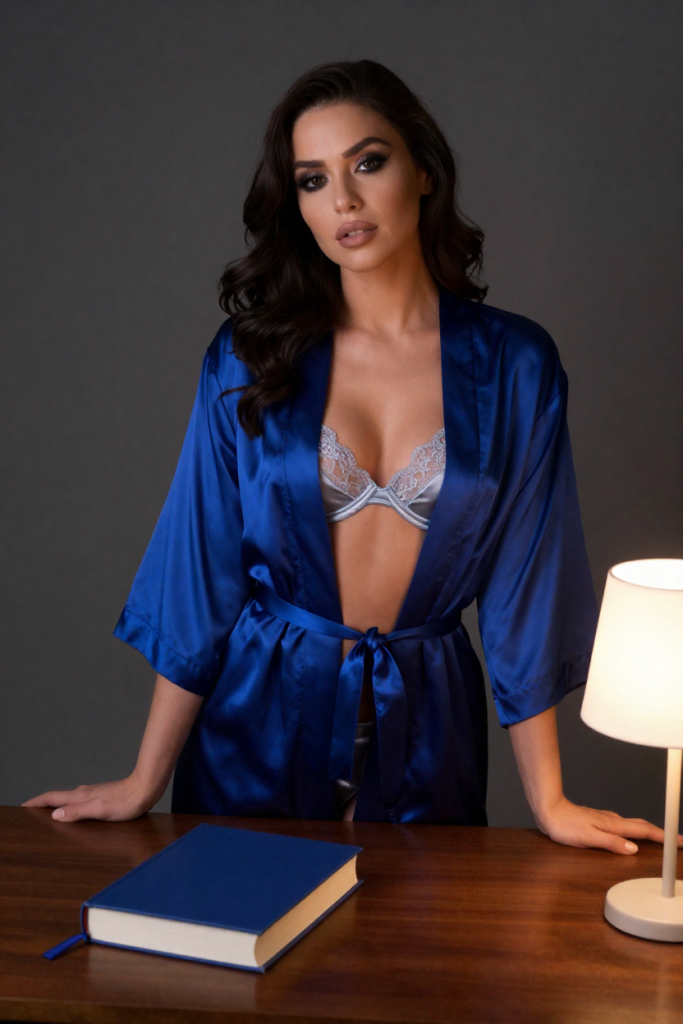
Visitors sometimes ask why a studio would choose the hardest light to work in. Lamplight flatters, window light romanticises, but the daylamp’s flat noon is the light of inspection — and inspection is this room’s trade. A character who reads as herself under the daylamp will read as herself anywhere; a character who needs kind light to survive was never settled, only lit.
The hardest light is the cheapest teacher
Faults found at the generator cost 6 credits. The same faults found at the editor cost 21, at the swap 26, at the upscaler 61 and in a published set, reputation. Unforgiving light moves fault-finding to the cheapest possible moment: hands that will not survive noon are culled before they are edited, faces that drift are caught before they are swapped. The lamp is not cruelty; it is accounting.
The biography beside it
The lamp never appears without the closed biography beside it — cover plain, pages blank of any lettering, ribbon trailing from the spine. The pair is the room’s signature and its method in one image: the book is the life, the daylight is the standard it is held to. When you brief a frame here, you are volunteering for inspection — and that is exactly why the frames survive it.
Questions
Do I have to include the daylamp in my frames?
No — it is the house’s own habit, not a rule for members. But judging each sitting once in hard, flat light will do the same work for your series.
Why is the book always closed?
Because nothing in it is meant to be read. A closed, letter-free cover keeps the frame about the woman and the sitting, never about text.
Does hard light suit every series?
The series can live in any light it likes. The judging should visit the hard light once, the way a tailor checks a seam under a lamp.